
Ask ten people who run a production music library, a sync or a production agency or an independent publisher what separates the companies that thrive from the ones that stall, and you will hear ten different answers. Better music. Better contacts. Better timing. All of those matter. But when you look closely at the music licensing businesses that grow year after year, a more consistent pattern appears: they treat licensing as a system, not a series of lucky placements. While sync licensing remains an important part of the industry, music licensing businesses operate across different models, from production music libraries and publishers to agencies working on a wide range of licensing opportunities.
That distinction matters more than ever. According to IFPI’s Global Music Report 2026, global synchronization revenue for recorded music declined 2.0% in 2025 after four consecutive years of growth, totalling USD 641 million. CISAC’s Global Collections Report 2025 shows audiovisual collections for creators rose only 1.1% in 2024, to €0.73 billion. Neither figure describes a collapsing market, but both describe one where growth is no longer handed out to everyone. In a flatter environment, the gap widens between companies that run disciplined operations and those that rely on volume and goodwill.
So what actually makes a music licensing business successful?
Below are the foundations we see again and again among the libraries, agencies and publishers that keep winning briefs, closing deals and retaining clients.
1- A Catalog With a Clear Identity
Size is not a strategy. A library with 200,000 tracks and no discernible point of view is harder to pitch than a tightly curated one that music supervisors associate with a specific sound, quality bar or use case. The most successful music licensing businesses know exactly what they are known for: cinematic trailer music, authentic regional genres, unscripted TV beds, brand-safe advertising tracks, or one-stop indie catalog with clean rights.
For production music libraries, this also means building a catalog that serves recurring client needs, offers a consistent musical identity and remains easy to navigate as it grows.
A clear identity does three things. It makes your pitches more relevant, because you are answering the briefs you are built to answer. It makes your business memorable, because supervisors and editors under deadline reach for the name that comes to mind first. And it makes acquisition and commissioning decisions easier, because every new track or composer either strengthens that identity or dilutes it.
In practice
Review your last twelve months of placements. Which genres, moods and media types consistently convert? That pattern is your real identity, whether or not it matches the one on your website.
2- METADATA TREATED AS REVENUE INFRASTRUCTURE
In music licensing, a track that cannot be found cannot be licensed, and a track whose rights are unclear cannot be cleared on deadline. Metadata is not an administrative afterthought. It is the infrastructure your revenue runs on.
Successful businesses invest in metadata at two levels. The first is discoverability: accurate genre, mood, tempo, instrumentation, vocal and lyrical theme tags that let a music supervisor or a trailer editor find the right cue in minutes. The second is rights data: writer and publisher splits, PRO affiliations, ISRCs and ISWCs, ownership of masters, and any restrictions on territory or media. When rights data is complete, one-stop clearance becomes a genuine selling point rather than a promise you scramble to keep.
Clean metadata also flows downstream. It feeds cue sheet accuracy, which directly affects whether performance royalties reach your composers and publishers. Every gap in your data is a potential leak in your income.
3- Relationships That Compound Over Time
Music licensing is a relationship-driven business. Whether working with music supervisors, production companies, broadcasters, advertising agencies or other licensing partners, successful businesses do more than build relationships: they manage them deliberately.
A music supervisor who licensed a track from you two years ago, an agency producer who loved your stems delivery, a post house editor who asks for the same kind of tension cue every season: each of these contacts carries context. What they briefed, what they passed on, what they paid, what deadlines they work to, which projects are coming up next. Businesses that capture and use that context pitch more precisely and follow up at the right moment. Businesses that keep it in one person’s inbox or memory lose it the day that person leaves or gets too busy.
Strong relationship management also means knowing who you have not spoken to in a while. Dormant clients are among the cheapest sources of new revenue in any licensing business, yet they are routinely overlooked because nobody is prompted to reach out.
Ask yourself
If your most connected team member left tomorrow, how much of your client history, pricing context and pitch knowledge would leave with them?
4- A Deal Pipeline You Can Actually See
Every licensing business has a pipeline, whether or not it is written down. Briefs come in, tracks are pitched, quotes are sent, terms are negotiated, licenses are issued and invoices are raised. The question is whether you can see that pipeline at a glance, or whether it lives across email threads, spreadsheets and sticky notes.
Successful music licensing companies track deals through clearly defined stages. That visibility answers questions that otherwise go unanswered: How many open quotes are waiting on a response? Which deals have stalled at negotiation? What is our expected revenue for the quarter? Which types of brief do we win most often, and which do we consistently lose?
Pipeline visibility turns licensing from a reactive activity into a manageable one, helping teams prioritize follow-ups, forecast revenue and identify opportunities across their business. It allows you to prioritize follow-ups, forecast with confidence and spot problems before they become missed revenue. It also helps you measure your own conversion rates internally, which is the only reliable way to know whether your pitching is improving.
5. Pricing Discipline and Rights Clarity
Inconsistent pricing quietly erodes margin and credibility. When two similar requests receive very different quotes because they were handled by different people or on different days, clients notice, and your negotiating position weakens.
The strongest businesses work from a clear pricing logic built around the variables that actually drive value: media, territory, term, usage type, exclusivity and the profile of the production. They know when a blanket license makes more sense than a single-use sync fee, and they understand how master use fees and synchronization fees interact on one-stop deals. They also track special terms carefully, from favored nations clauses to option periods, so that renewals and extensions are handled correctly rather than renegotiated from scratch.
Rights clarity is the other half of the equation. Knowing exactly what you control, and what you do not, lets you quote quickly and confidently. Speed matters in sync: when a supervisor is clearing music on a tight post-production schedule, the library that confirms rights and pricing first often wins the placement.
6- DIVERSIFIED REVENUE STREAMS
Relying entirely on one-off licensing fees leaves a business exposed to the natural peaks and troughs of production schedules, client demand and advertising budgets.
- Single-use sync licenses for film, TV, advertising, trailers and games.
- Blanket licenses and subscriptions for broadcasters, production companies and content creators who need ongoing access.
- Performance royalties collected through PROs, which depend on accurate cue sheets and registrations.
- Renewals and extensions of existing licenses when term or territory expires.
- Custom and commissioned music for clients who need something bespoke.
- Sub-publishing and representation deals that extend a catalog’s reach into new territories.
Each stream has its own cycle and its own administration. Managing them well requires knowing which clients are on which agreement, when each agreement renews and which placements still need follow-up on royalty registration.
7- OPERATIONS THAT SCALE WITHOUT ADDING CHAOS
Growth brings complexity. As music licensing businesses expand their catalogs, client base and licensing activities, managing everything through disconnected spreadsheets, email threads and manual processes becomes increasingly difficult.
Efficient operations help teams maintain visibility, reduce administrative work and ensure that important information is accessible when it is needed. Clear workflows also make it easier to coordinate teams, follow up on opportunities and manage a growing volume of licensing activity without compromising service quality.
For production music libraries and other licensing businesses alike, the ability to scale operations is essential to sustainable growth.
Warning signs your operations are holding you back?
If your team spends more time managing information than acting on opportunities, it may be time to rethink your processes and tools.
8- Trust With Composers and Rights Holders
A licensing business is only as strong as the music it can offer, and the best composers, artists and rights holders have options. They stay with the companies that treat them fairly and communicate transparently.
That means accurate and timely royalty reporting, clear accounting of which placements generated which income, and honest communication about how their music is being pitched. Libraries and publishers known for clean reporting attract better talent, which in turn strengthens the catalog identity discussed above. It is a virtuous circle, and it starts with reliable data.
9- Data-Driven Decisions and Business Performance
The final ingredient ties the others together. Successful music licensing businesses make decisions based on what their own history tells them, not on instinct alone.
Which genres are winning briefs this year? Which client segments renew most often? Which composers generate the most placements per track? Which pitches convert, and how long does a typical deal take from brief to signed license? When this information is captured consistently, it informs where to commission new music, which clients to prioritize and how to allocate the team’s time. When it is not captured, the business is essentially guessing.
10- Where a Music Licensing CRM Fits In
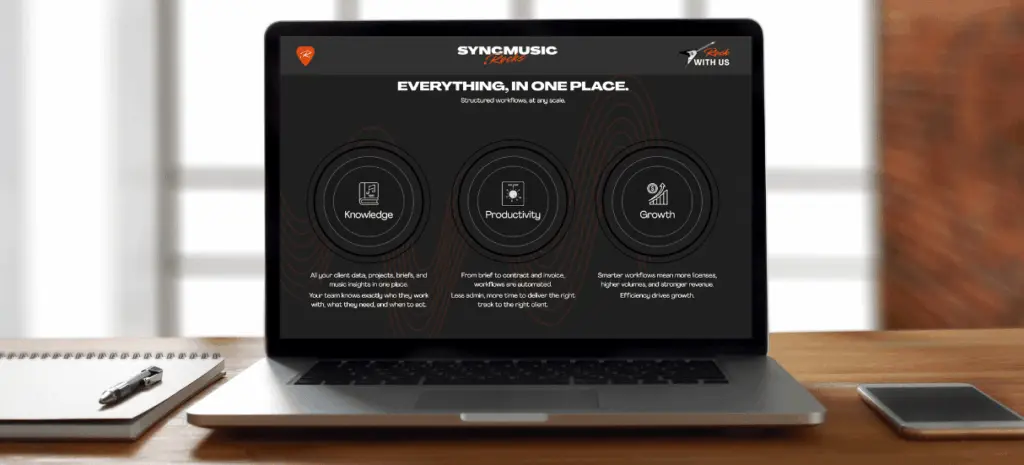
Look back at the foundations above and a common thread appears. Relationship context, deal stages, pricing history, renewals, revenue streams and reporting all depend on having structured, connected information about your clients and your deals. That is exactly what a CRM designed for music licensing provides.
Generic CRMs were built for traditional sales processes, not necessarily for the specific requirements of music licensing: briefs, multiple rights holders, licensing terms, renewals, cue sheets and complex client relationships. SyncMusic.Rocks (SMR) was built specifically for music licensing professionals, with workflows designed to support the operational needs of libraries, sync agencies, publishers and independent labels.
SMR offers three paths depending on how your business operates:
- Core: built on Microsoft Dynamics 365, giving licensing teams a structured foundation for deal tracking, relationship management and pipeline visibility.
- RockStar: a fully custom, enterprise-scale solution for organizations with complex structures, high deal volumes and specific workflow requirements.
- SMOH (SyncMusic Operations Hub): SMR’s in-house operations platform, developed by our own team to centralise licensing operations under full control.
Whichever path fits, SMR connects to the catalog website you already use, so your music stays where your clients find it while every brief, quote, license and relationship is tracked in one place.
FREQUENTLY ASKED QUESTIONS
What is the most important factor in a successful music licensing business?
There is no single factor, but the businesses that perform consistently combine a catalog with a clear identity, accurate metadata, well-managed relationships and a visible deal pipeline. Strong music opens doors; strong operations keep them open.
How do music licensing companies make money?
Music licensing businesses generate revenue through a variety of models, including single-use licenses, blanket agreements, subscriptions, performance royalties, renewals, commissioned music and sub-publishing or representation deals. The right mix depends on the company’s catalog, clients and business model.
Why does metadata matter so much in music licensing?
Metadata determines whether a track can be found during a search and cleared quickly once it is chosen. Complete rights data also supports accurate cue sheets, which affects whether performance royalties reach composers and publishers.
Does a small music library need a CRM?
Yes, in most cases. The habits that make larger businesses successful, such as tracking briefs, following up on quotes and anticipating renewals, are far easier to build early than to retrofit once the team and client base have grown.
Conclusion: Success Is Built, Not Found
Great placements will always feel a little like magic. But behind the music licensing businesses that grow steadily, the magic is supported by structure: a catalog that knows what it is, metadata that can be trusted, relationships that are nurtured deliberately, a pipeline that is always visible and decisions grounded in real data. In a market where growth is no longer automatic, those operational foundations are what separate the companies that thrive from the ones that simply survive.
If you want to see how SMR can help your team track every brief, deal and relationship in one place, book a demo with the SMR team and explore which solution fits the way you work.