
Why the data attached to every cue now decides how fast you get licensed, how confidently you get cleared, and whether you get paid. A guide for production music libraries, sync agencies and bespoke composers.
On November 19, the music data world gathers in Toronto for the DDEX MusicTech 20/20 Summit. Ahead of the event, Mark Isherwood, who has run the DDEX Secretariat since the standards body was formed in 2006, told Music Business Worldwide that “the single biggest problem that remains unsolved is having available, to everyone, authoritative links between musical works (ISWCs) and sound recordings (ISRCs).”
In May 2026, BMI announced it would acquire Soundmouse, the cue sheet reporting and monitoring platform, from Orfium, with the stated ambition of building “the largest and most comprehensive cue sheet database in the global audiovisual marketplace.”
Put those two stories side by side and a pattern emerges. The organizations that move money through the music business are investing in data, because data is where money gets lost. For anyone licensing music into picture, that is not an abstract infrastructure debate. It touches every brief you answer, every quote you send and every cue sheet that does, or does not, turn into a royalty statement.
This article looks at why metadata has moved from a back-office chore to a strategic asset, what that means specifically for production music libraries, sync agencies and bespoke composers, and how to build workflows where the right information travels with every deal.
What “Metadata” Actually Means in Music Licensing
In a licensing context, metadata is not one thing. It is at least three distinct layers of information, each serving a different person at a different moment in the life of a track.
Creative and descriptive Metadata
Genre, mood, tempo, key, instrumentation, vocal or instrumental, energy curve, era, comparable artists, available stems and alternate mixes. This is the layer a music supervisor, editor or agency producer uses to find a track. If it is thin or inconsistent, the track effectively does not exist in a search.
Ownership and rights metadata
Writers and publishers, their IPI numbers, PRO affiliations and ownership splits; master owners; the ISRC that identifies the recording and the ISWC that identifies the underlying composition; territorial restrictions and any pre-cleared or one-stop status. This is the layer that lets a clearance team say yes quickly and confidently.
Usage and performance metadata
What was licensed, to whom, for which media, territory and term, at what fee, and how the music actually appeared on screen: duration, use type (background, featured, theme) and placement. Much of this ends up on a cue sheet, which is the document performing rights organizations rely on to distribute performance royalties.
The important point is that these layers are connected. A descriptive tag gets a track shortlisted, the rights data gets it cleared, and the usage data gets everyone paid. A break anywhere along that chain costs someone time or money.
Key Takeaway
Metadata is not just tagging. In licensing, it is the chain that connects discovery, clearance and payment. Treat each layer as part of the same workflow, not as separate admin tasks owned by different people.
WHY THE STAKES KEEP RISING
The amount of money flowing through collective rights systems has never been higher. According to CISAC’s Global Collections Report 2025, creators’ royalties collected by its network of 228 societies in 111 countries reached a record €13.97 billion in 2024, up 6.6% year on year. TV and radio accounted for €3.9 billion of that total, and digital passed €5 billion for the first time.
Every one of those euros has to be matched to a work and to the people who own it before it can be paid out. When matching fails, money sits unclaimed. The clearest public illustration came in February 2021, when the Mechanical Licensing Collective in the United States announced it had received $424,384,787 in accrued historical unmatched royalties from digital services. These were, in the MLC’s words, royalties “yet to be distributed by streaming services because a composition’s owners could not be determined.”
That example comes from streaming mechanicals, not sync. But the mechanism is identical in audiovisual: an unidentified writer, a missing IPI, a cue sheet listing a generic title instead of the actual work, and the money stalls. As far back as 2015, Berklee’s Rethink Music initiative noted in its Fair Music report that “multiple estimates indicate that anywhere from 20-50 percent of music payments do not make it to their rightful owners,” and pointed to the lack of back-end technology as a core cause.
At the same time, the volume of music competing for every brief keeps growing, and buyers expect faster answers. Rich, accurate metadata is now what separates a cue that gets found, cleared and paid from one that does not.
Production Music: Metadata Is Both the Storefront and the Royalty Engine
For production music libraries, metadata does double duty. It powers discovery on the front end and royalty collection on the back end, and both sides are under pressure.
Discovery depends on consistent tagging
A library’s search is only as good as the descriptions behind it. The difficulty is that human tagging is subjective: two editors can describe the same cue in completely different words. That inconsistency is one reason AI-assisted tagging has moved into mainstream library workflows. When APM Music, which describes itself as the largest production music library in North America, announced its partnership with Cyanite, the stated goal was to “introduce human-assisted auto-tagging to the music submission and review process, thus increasing the quality and consistency of tagging.”
Note the phrase “human-assisted.” The most effective approach combines machine consistency with editorial judgment: the model produces a reliable baseline of mood, genre, tempo and instrumentation, and a human adds the context a search algorithm cannot infer, such as how a cue builds, where it edits cleanly, or which brief it was written for.
Versions multiply the metadata burden
A single production music track rarely ships alone. Full mix, underscore, 60, 30 and 15 second cutdowns, stingers, stems: each version needs to inherit the correct ownership data while carrying its own descriptive details. When a 30 second edit is licensed for a broadcast spot and the cue sheet lists the parent track incorrectly, or not at all, the performance royalty can be lost.
Cue sheets remain the weak link
The Production Music Association, which represents production music libraries in the United States, put it bluntly in comments to the U.S. Copyright Office: “The cue sheet reporting system in the United States is broken in several facets.” The PMA described cue sheets “prepared and filed in multiple, disparate formats” and noted that compliance is “often left to the good graces of the licensee or their content producers.” It also gave a telling example of works being rolled into generic titles such as “Grey’s Anatomy Cues.”
For a library, that means the quality of its own metadata is necessary but not sufficient. It also needs a clear record of every license it has granted, so it can check what should appear on a cue sheet against what actually does.
For Production Music Libraries
- Standardize your tag vocabulary and apply it consistently, whether tags come from editors, composers or an AI tool.
- Make sure every alternate version and cutdown inherits the parent track’s writer, publisher, IPI and split data.
- Keep a reliable record of every license (production, broadcaster, territory, term, version used) so you can reconcile it against cue sheets and royalty statements.
Sync Licensing: Metadata Decides Clearance Speed
In sync, time is often the scarcest resource. A supervisor working against a lock date needs to know, quickly and with certainty, who controls both sides of a track and whether it can be cleared for the requested media, territory and term.
That certainty comes from ownership metadata. As Synchtank noted in a March 2026 article on cue sheets, the ISRC identifies the recording, but proper reporting “demands the ISWC,” along with “the specific IPI (Interested Parties Information) numbers of all writers and publishers involved, as well as the exact percentage splits of ownership.”
This is exactly where the ISWC to ISRC link Mark Isherwood describes becomes a practical problem rather than a technical one. If a sync agency represents a master but cannot confidently identify every party behind the underlying composition, clearance slows down, quotes go out with caveats, and some opportunities simply go to a more clearly documented track. Isherwood also observed that many companies hold “extensive numbers of links” between works and recordings, but treat them as a competitive advantage rather than shared infrastructure.
For sync agencies, the lesson is direct: accurate, complete ownership data is a selling point. A track that arrives with clean splits, confirmed IPIs and clear one-stop or two-stop status is a track a supervisor can say yes to.
For Sync Agencies
- Confirm both master and publishing ownership, with splits and IPIs, before a track goes into pitches.
- Flag one-stop status and any restrictions (territories, media, brand categories) clearly in every pitch.
- Log every request, quote and license against the specific track and version, so rights questions can be answered in minutes, not days.
Bespoke Music: Metadata Starts at the Commission
Custom and commissioned music has its own metadata challenge: the track does not exist when the deal begins. The brief, the fee, the ownership terms and the deliverables are agreed first, and the music follows, often through several rounds of revisions.
That sequence creates specific risks. Ownership terms vary widely from one bespoke deal to the next. A buyout or work-for-hire arrangement may transfer the copyright to the client, while the composer may still be entitled to the writer share of performance royalties depending on the agreement and the territory. If those terms live only in an email thread or a signed PDF, nobody downstream can register the work correctly or check that the cue sheet reflects them.
Versioning is the second risk. A bespoke project can produce several approved edits for different platforms and cutdowns. Each one may be used in a different placement, and each needs to be identifiable on a cue sheet.
The fix is to treat metadata as part of the deal from day one. When the brief comes in, capture the client, the project, the agreed ownership and royalty terms, the media and territories, and the expected deliverables. When the music is delivered, attach the final titles, versions, writers, IPIs and splits to that same record. Registration and cue sheet reporting then start from documented facts rather than memory.
For Bespoke Composers and Studios
- Record ownership and royalty terms at the moment the deal is agreed, not after delivery.
- Give every approved version a distinct, consistent title and keep it linked to the original commission.
- Register works promptly once terms and splits are confirmed, and keep a record of which placement each version went to.
Cue Sheets Are Metadata
Across all three business models, one document keeps coming back: the cue sheet. A cue sheet is metadata. When it contains missing or wrong information, the best case is a round of queries with the PRO and delayed royalties. The worst case is a cue sheet the PRO rejects outright. And the hardest part is rarely the form itself: it is finding correct, up-to-date writer, publisher and PRO information.
Standardization is moving, slowly. The current global standard is CISAC AVR, with a Global Cue Sheet Standard 2.0 being developed by CISAC, the Society Publisher Forum and IFPI. As early as 2019, DDEX and EIDR, the registry that identifies film and TV assets, announced an alliance to build a common language between music and visual media, with cue sheet standards among its stated priorities.
The BMI and Soundmouse deal shows where the industry is heading. Soundmouse uses AI-driven technology to automate cue sheet creation and monitors television, radio and music usage worldwide. BMI CEO Mike O’Neill framed the acquisition around one goal: building the most comprehensive cue sheet database so that BMI is “in the best position to collect and distribute the royalties” its members are entitled to.
Automated monitoring and matching can only be as accurate as the reference data behind them. The better the metadata rights holders supply, the more of their usage these systems can correctly identify.
AI RaiseS the Bar Twice
Artificial intelligence affects music metadata in two distinct ways, and licensing professionals need to watch both.
AI as a tagging and search tool
As described above, AI tagging is now part of how libraries describe music at scale. Tools like Cyanite analyze the audio itself rather than existing embedded metadata, producing consistent descriptors that improve search. Used well, this frees editorial teams to focus on the context and curation that machines cannot provide.
AI as something metadata must disclose
The second shift is newer. In September 2025, Spotify announced it would adopt a DDEX standard for AI disclosures in music credits, under which labels, distributors and partners submit standardized information on whether AI was used for vocals, instrumentation or post-production. Spotify’s Sam Duboff explained that the standard “won’t force tracks into a false binary where a song either has to be categorically AI or not AI at all.”
In Europe, the AI Act requires providers of general-purpose AI models to identify and respect rights reservations expressed by rights holders. In December 2025, the European Commission opened a consultation on machine-readable opt-out protocols for text and data mining, with the aim of agreeing a list of solutions it will publish and review regularly.
For sync and production music, the implication is clear. Buyers increasingly want to know how a track was made, and rights holders increasingly need to express, in a machine-readable way, how their music may and may not be used. Both are metadata questions. Libraries and agencies that can document AI involvement and usage permissions accurately will be better placed with risk-conscious clients such as brands, broadcasters and streamers.
Key Takeaway
AI makes good metadata easier to produce and more important to get right. Expect clients and platforms to ask how tracks were created and expect rights reservations to be expressed as data rather than just contract language.
Where Metadata Breaks Down
In practice, metadata rarely fails because someone does not care. It fails at handoffs, the moments when information moves from one person, team or system to another:
- Composer to library or agency: splits, IPIs and co-writer details are submitted incompletely, or in a different format each time.
- Pitch to license: the version that was pitched is not the version that was licensed, and nobody updates the record.
- License to cue sheet: the production company or broadcaster files the cue sheet, but the licensor has no easy way to check it against what was agreed.
- Deal to royalty statement: months later, a royalty line arrives (or does not) and someone has to reconstruct which license it relates to.
- Sub-publishers and partners: data is re-keyed into another system in another territory, and errors multiply.
Each of these handoffs is a relationship and a transaction as much as a data problem. That is why spreadsheets and inboxes struggle: they hold information, but they do not connect it to the deal, the contact and the next action.
A Practical Metadata Checklist for Licensing Teams
Before a track is pitched
- Writers, publishers, IPIs, PRO affiliations and splits confirmed and totalling 100% on each side
- ISRC for the recording, ISWC (or a registration in progress) for the composition
- Master ownership and one-stop status documented
- Consistent descriptive tags, including versions, stems and edit points
- AI involvement documented where relevant
When a deal is agreed
- Client, production, media, territory, term and fee recorded against the exact track and version
- Ownership and royalty terms captured for bespoke and custom work
- Cue sheet responsibility and expected filing confirmed with the client
After the placement
- Cue sheet checked against the license once available
- Royalty statements reconciled against licensed placements
- Discrepancies logged and followed up with the PRO, broadcaster or production
Connecting Metadata to Deals and Relationships
None of this checklist works if the information lives in five different places. The licensing teams that handle metadata best are the ones that connect it to their day-to-day commercial activity: every request, quote, license and follow-up tied to the right contact, the right production and the right track.
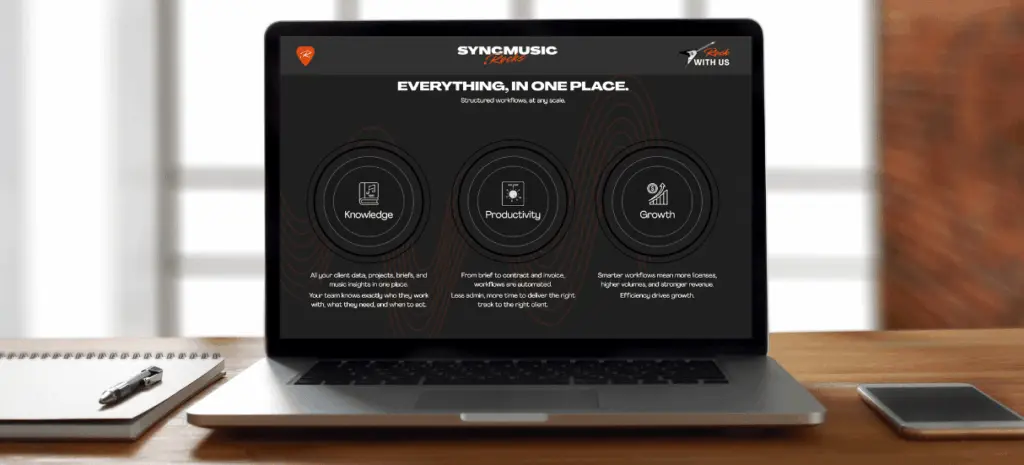
This is the gap SyncMusic.Rocks was built to close. SMR is a CRM designed exclusively for music licensing professionals, focused on deal tracking, relationship management and pipeline visibility. Rather than replacing the catalog site a library already uses, SMR connects to it, so commercial activity and track information sit side by side. Whether a team runs on SMR Core, built on Microsoft Dynamics 365, on a fully custom RockStar environment for enterprise-scale operations, or on SMOH, the SyncMusic Operations Hub developed in-house by SMR, the principle is the same: the data captured when a deal is made should still be there, intact, when it is time to report, reconcile and get paid.
CONCLUSION: Metadata Is Now a Commercial Discipline
The direction of travel is unmistakable. PROs are buying cue sheet infrastructure, standards bodies are tackling the link between works and recordings, streaming platforms are building AI disclosure into credits, and regulators are asking for machine-readable rights reservations. Each of these developments rewards rights holders who can supply clean, complete and connected data.
For production music libraries, that means consistent tagging and rigorous version control. For sync agencies, it means ownership data clear enough to win the clearance race. For bespoke composers, it means capturing terms and versions from the very first brief. And for all three, it means treating metadata not as admin, but as part of how deals are won, delivered and paid.
Want to see how SMR keeps licensing data connected from first request to final royalty? Book a demo with the SyncMusic.Rocks team.
- Music Business Worldwide, “Linking songs to recordings is music data’s single biggest unsolved problem”
- BMI, “BMI Announces Agreement to Acquire Soundmouse, a Global Leader in Cue Sheet Management”
- GEMA, summary of the CISAC Global 3. Music Business Worldwide, “BMI to acquire Soundmouse from Orfium”
- The MLC, “The MLC Receives Over $424M in Unmatched ‘Black Box’ Streaming Royalties”
- Berklee College of Music, “BerkleeICE’s Rethink Music Releases Report on Transparency and Fairness in the Music Industry”
- Cyanite, “APM Music and Cyanite partnership”
- Cyanite, “AI Auto-Tagging for Music Catalogs”
- Production Music Association, comments to the U.S. Copyright Office Music Licensing Study
- Synchtank, “Everything You Didn’t Know About Cue Sheets (But Should)”
- Synchtank, “Building Smarter Cue Sheets in a Digital World”
- Digital Music News, “Groundbreaking Metadata Alliance Announced Between Music, Film, TV Industries”
- TechCrunch, “Spotify updates AI policy to label tracks, cut down on spam”
- CEPIC, “European Commission launches consultation on AI Act opt-out protocols for text and data mining”