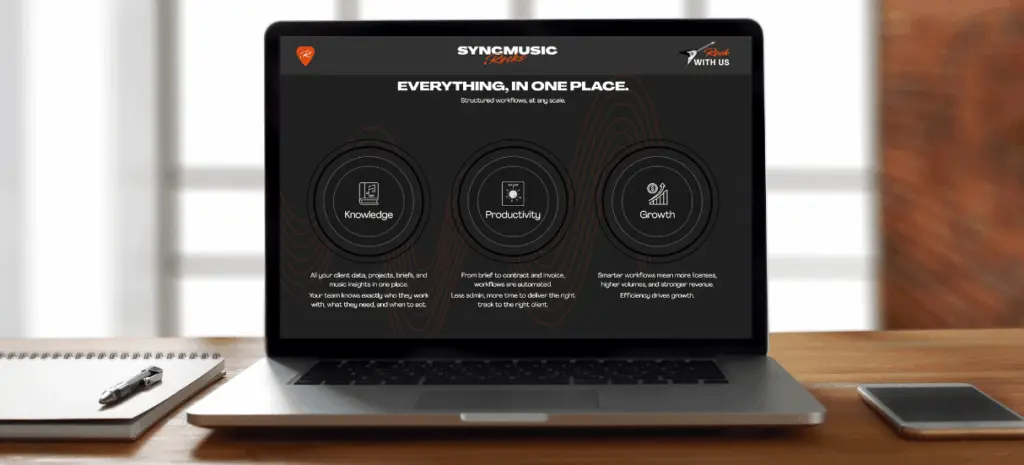

Most music licensing teams don’t think they have a systems problem. They have a spreadsheet, an inbox, a shared folder, and a process that’s ‘been working for years.’, but which is not a proper music licensing CRM. The deals get done. The invoices get sent. The contracts get signed, eventually.
But working isn’t the same as working well. And in licensing, the gap between the two is quietly costing teams far more than they realise.
28%
of a rep’s time goes to actual revenue work
$650M
global sync revenue in 2024, +7.4% YoY
20-30%
drop in forecast accuracy on fragmented data
75%
lose clients to poor data & weak follow-up
The System Nobody Talks About
Before the numbers, name the system most licensing teams actually run on. A brief arrives by email and gets forwarded. Someone builds a playlist in a Drive folder and sends a link. The negotiation happens across three email threads and two WhatsApp chats. The agreement is drafted in Word, chased, signed via DocuSign, and noted in a spreadsheet - sometimes. The invoice goes out from a separate accounting tool.
Brief → Playlist → Agreement → Invoice
That’s not a workflow. It’s six tools, zero integration, and a pipeline that exists entirely in people’s heads. The cost doesn’t show up as a line item – it shows up as deals that quietly die, follow-ups that never happen, and relationships that go cold because nobody had visibility at the right moment.
01 – The Time Tax
Your best people spend most of the week on work that isn’t the work.
28%
of a rep’s time goes to actual revenue-generating activity. The rest disappears into admin, data entry, and chasing information that should already be in a system.
Salesforce, State of Sales
For a music licensing team, that translates directly: your most valuable people spend the majority of their week on tasks a properly structured system would capture automatically - not on relationships, catalogue, and creative work.
02 – The Invisible Deal Loss
The deals you lose don’t appear on a P&L. They’re real anyway.
Time is the cost you can measure. The deals you lose are harder to quantify ; but they're real.

A brief buried in a shared inbox. A follow-up no one was tracking. A renewal that lapsed because the team had no clear view of contract end dates. A relationship that cooled because a supervisor moved on and no one had documented the history.
$650M
in global recorded-music sync revenue in 2024 – a fourth straight year of growth, up 7.4% YoY.
Industry research, CRM data quality
03 – The license-terms Risk
Music licensing isn’t a standard sales process, and generic tools weren’t built for it.
Every deal carries layers a CRM-for-everyone never anticipated: license type, territory, media, term length, use, MFN, exclusivity, renewal windows. When those details live in Word documents and spreadsheet rows maintained by whoever had time last week, the risk isn't just inefficiency, it's exposure. Missed renewal clauses mean lapsed rights and lost income.

A system built for sync tracks those terms as structured data, not buried prose. That's the difference between knowing your exposure and discovering it.
04 – The Forecasting Blind Spot
“Roughly accurate” is not a pipeline. It’s a guess.
20-30%
drop in forecast accuracy when data is fragmented across tools, versus teams on an integrated system.
CRM data-quality research
That means resource planning, capacity decisions, and revenue projections are all built on a guess. This is where the system should stop being a record and start being an advisor – reading the signals across your accounts, forecasting where deals are heading, and pointing to opportunities (even ones not yet in your pipeline) instead of waiting for you to find them.
05 – The Relationship Cost
In Sync, the relationship is the business
Supervisors move fast. They build loyalty to the people who respond quickly, know their preferences, and make their job easier. When a brief gets a response that reflects no institutional memory – wrong genre, wrong mood, no acknowledgment of past conversations, that relationship erodes.
75%
of businesses report losing customers to poor data quality and the weak outreach it causes.
Industry research, CRM data quality
A proper system tracks supervisors, not just deals: the briefs they’ve sent, the tracks they’ve responded to, their history with the team. That context is relationship capital, and when it lives in one person’s memory, it walks out the door when they leave.
What This Looks Like in Practice
Without a system
- Brief forwarded to three people
- Playlist link emailed from Drive
- Terms agreed over WhatsApp
- Word doc chased, signed, re-keyed
- Invoice from a separate tool
6 tools · 0 integration · 0 visibility
With SyncMusic.Rocks
- Brief captured, linked to contact
- Playlist built in the same place
- Terms logged as the deal moves
- Agreement & invoice auto-generate
- Pipeline updates in real time
1 flow · 0 re-entry · full visibility
The Real Calculation
The hidden cost isn’t just the hours lost to admin. It’s the deals that quietly die for lack of follow-up, the rights that lapse for lack of tracking, the relationships that cool because no one had context, and the forecasts that are wrong because the data lives in six places.
The question isn’t whether your team is capable. It almost certainly is. The question is whether your infrastructure is keeping up with the work, and whether it’s doing any of the thinking with you.
SMR’s Checklist: Signs Your Systems Are Costing You Deals
- Your pipeline lives mostly in spreadsheets updated by whoever had time
- Briefs regularly sit unanswered for more than 24-48 hours
- You’ve lost a deal because a follow-up didn’t happen
- Contract renewal windows are tracked manually, if at all
- You can’t produce a real-time pipeline view without asking several people
- New team members struggle to pick up relationships, context isn’t documented
- You use more than four tools to complete a single deal
A few cracks – worth watching before they widen.
- Salesforce State of Sales Report 2024
- ZoomInfo: Poor Data Quality Impact
- Landbase: The Real Cost of Bad CRM Data
- Fullcast: The Cost of Bad CRM Data and How to Fix It
- BeyondCRM: Poor CRM Data: 7 Shocking Costs
- eSignGlobal: Managing Music Licensing Contracts
- Sales Productivity Statistics 2026 – SalesSo
- DevRev: Why Sales Reps Hate Their CRM
- Grow Market Reports: Sync Licensing Market Research Report 2033