At some point, every licensing team faces the same decision: which CRM should we run our business on?
The options range from generic sales platforms to music-specialist tools to purpose-built ecosystems, and they are not equal. Choosing the wrong one doesn’t just slow your team down – it shapes how you scale, what your pipeline looks like in two years, and whether your people spend their days on relationships or on admin.
This is a structured breakdown of what’s available, what each option actually does in a sync and production-music context, and how to match the right solution to your operation. No hype. No feature padding. Just the decision, laid out clearly.
How to Read This Guide
Every option below is evaluated against the same four questions that matter in music licensing:

1- Does it handle the full deal lifecycle, from brief to invoice, without switching tools?
2- Does it understand sync-specific data: license type, territory, term, hold, clearance?
3- Can it scale with a growing team without becoming a development project?
4- What does it actually cost, in money, time, and operational overhead?

Keep that four-question test in mind. We'll return to it in the comparison at the end.
SOME NUMBERS
$25K+
minimum implementation cost for a standard Salesforce deployment, before any music-specific customisation. Salesforce / Folio3, 2025
6-12 Months
typical timeline for a complex CRM implementation involving custom workflows and integrations. Cube84 / Ascendix, 2025
$150K – $1.5M
total cost of ownership for a 100-user Salesforce deployment over three years. Insightly CRM Research, 2025
Option 01: Generic CRM Platforms
Salesforce · HubSpot · Pipedrive · Zoho
🟡 Verdict: a short-term starting point, not a long-term answer. Viable for small teams with limited budget and internal dev capacity. Not built for a serious licensing operation.
These are the dominant players in the global CRM market: mature codebases, deep documentation, large partner ecosystems. For a conventional B2B sales team, they work well out of the box.

For a music licensing operation, the problem is structural. These platforms were architected around a linear sales motion - prospect, qualify, propose, close. Sync and production-music deals don't move in a straight line. A brief can trigger a hold, a hold can become a pitch, a pitch can sit in approval for three weeks, and the deal can close - or die - without ever becoming a formal "opportunity."

License type, territorial scope, exclusivity windows, MFN clauses, renewal rights - none of these exist as native fields. You build them. Or your developer does, and then maintains them every time the platform updates. Generic CRMs are endlessly configurable, right up to the point where the configuration becomes the product. When your team spends more time managing the CRM than working deals, you've crossed that line.
Option 02: The DIY Stack
Airtable · Notion · Google Sheets · Excel
🟠 Verdict: fine at the very start, but the ceiling arrives fast. Acceptable for a small team and a contained catalogue. Migrating later always costs more than starting right.
Before reaching for a CRM, most licensing teams build something themselves. A well-structured Airtable base can track briefs, contacts, and deal stages. Notion can hold relationship notes. A shared sheet can serve as a rough dashboard. For two or three people managing a contained catalogue, it can genuinely work.

The problem is scale. As deal volume and team size grow, these tools hit a ceiling that reveals itself gradually: no audit trail, no single view of a client across multiple deals, no document generation, no revenue forecasting - and hard limits on how many records they hold. The system doesn't break. It just quietly fails to keep up.

And the moment a team member leaves and takes their relationship context with them, the limit becomes obvious. Institutional knowledge living in someone's head isn't a system - it's a liability.
option 03: Microsoft Dynamics 365
Airtable · Notion · Google Sheets · Excel
🟠 Verdict: excellent at their niche, but point solutions, not a full CRM. The right complement to a CRM, not a replacement for one.
This is the category most sync and production-music teams already use in some form – and the live market reality a generic-CRM comparison usually ignores. Each is strong at what it was built for:
- DISCO – catalogue organisation, playlisting, and pitching/sharing music with supervisors
- Synchtank – rights management, royalty accounting, and licensing administration
- Source Audio – music search and discovery across large production-music libraries
- Soundmouse – music reporting, metadata, and broadcast cue-sheet workflows
The limit is scope. These tools own a slice of the lifecycle – discovery, pitching, rights, or reporting – but none carries a deal from brief through pitch, hold, clearance, contract, and invoice in one place, with full pipeline visibility and relationship history across every client. Teams end up stitching two or three of them together with a CRM or a spreadsheet in the middle. They solve a problem. They don’t unify the operation.
option 04: Microsoft Dynamics 365
Enterprise-grade · Microsoft ecosystem · Highly configurable · Secure
🟢 Verdict: The strongest technical backbone available, once it’s configured for sync. On its own, it needs significant specialist work to get there.
Dynamics 365 operates at a different level from the options above: an enterprise CRM with native integration across Outlook, Teams, SharePoint, Excel, Power BI, and Azure. For organisations already on Microsoft 365, the operational continuity is a real advantage. It handles complexity well — multi-entity relationships, advanced automation, role-based access, deep reporting — and scales from a 10-person team to a global organisation without an architectural rethink.

What it does not do, by itself, is speak sync. A standard deployment has no concept of a brief, a hold, a clearance window, or a production-library pitch. Getting there requires configuration — and configuration requires someone who knows both Dynamics 365 and music licensing deeply enough to bridge them. That's exactly the gap the next option closes.
OPtion 05: syncmusic.rocks
The configuration, shipped as the product
This is where the enterprise capability of Dynamics 365 meets industry configuration out of the box – across three tiers built for different stages of an operation.
SyncMusic Core: Operational From Day One
🟢 Verdict: the right entry point for independent labels, sync agencies, and licensing teams up to ~20 people. Deploy in days. No IT project. No workarounds.
Built on Dynamics 365 and pre-configured for music licensing. The data model, the pipeline stages, the workflows, all of it reflects how a sync deal actually moves. No custom development required. Transparent pricing: one setup fee, per-seat licence, optional integrations billed per connection.
- Pipeline structured around the licensing lifecycle: brief → pitch → hold → clearance → contract → invoice
- Catalogue management linked directly to deal records and revenue tracking
- Contact and company management built for supervisors, clients, publishers, and labels
- Reminders, renewal alerts, and deadline tracking so nothing falls through the cracks
- Live dashboards: pipeline health, team performance, revenue forecast
- Full support and platform updates included in the subscription
SyncMusic RockStar: When Standard Doesn’t Fit
🟢 Verdict: For labels, publishers, and distributors managing high-volume, multi-territory operations. The right choice when your organisation has outgrown templates.
A fully custom CRM built around the specific structure of your operation. Not a product deployment – a strategic engagement. RockStar is for organisations where the complexity of the catalog, the deal volume, or the integration requirements goes beyond what a pre-configured system can address.
- 200+ integrations with existing internal and external systems
- Custom data models, pipeline logic, and automation built to your exact workflow
- AI enrichment across catalog metadata, contact intelligence, and deal scoring
- Dedicated account management and backstage-level technical support
SMOH.Rocks: One Platform to rule them all – Our new upcoming solution
🟢 Verdict: for teams that want full operational independence and a single platform connecting every function.
A 100% proprietary platform — no Microsoft licence, no third-party infrastructure embedded in the subscription. Every layer is owned and maintained by SyncMusic.Rocks, which means the roadmap is shaped entirely by what licensing teams need.
- E-signature, ERP, and client portal — all native, all connected
- The full licensing pipeline, from member onboarding to signed invoice, in one system
- ML-powered brief matching and music search across 200+ sync categories
- Native marketing suite: campaigns, automation, segmentation, customer journeys, landing pages
- Live KPI dashboards: revenue, royalty flows, deal performance, team activity
- Auto-generated documents: contracts, invoices, and reports from templates
SMOH Indicative Pricing
Basic: $599/mo · 3 users · all features included
Pro: $999/mo · 5 users · advanced support
Full: $1,799/mo · 10 users · priority support + dedicated account manager Annual billing: 10% discount.
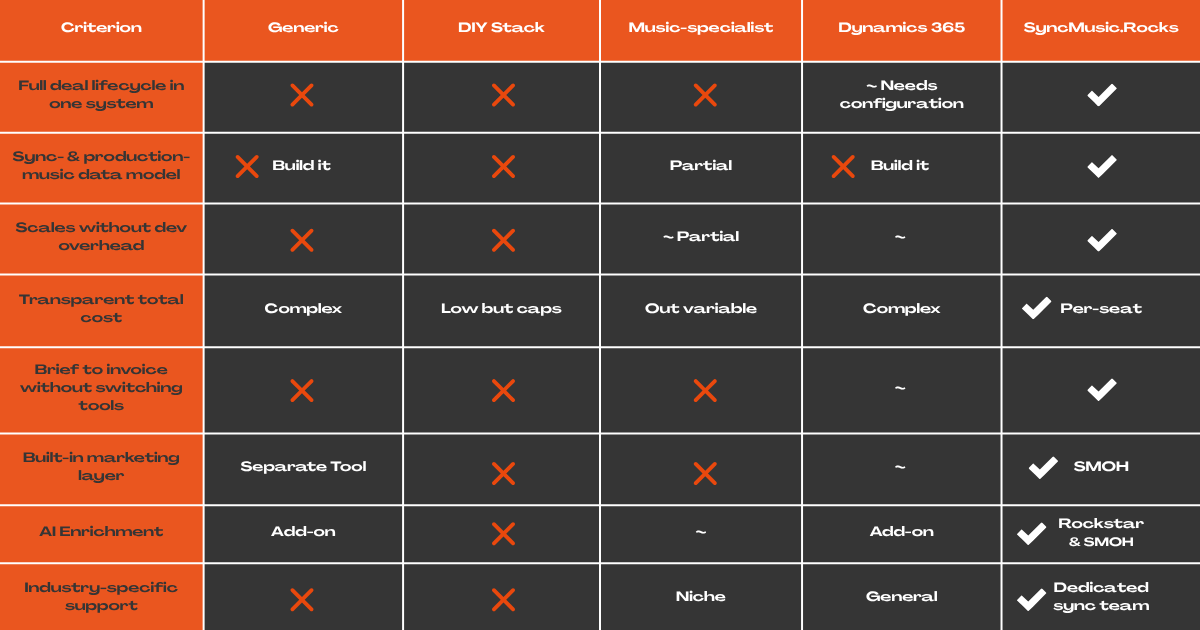
The Criteria That Matter, Side by Side
Matching the Solution to the Operation
The right CRM isn’t the most powerful one. It’s the one that fits the structure of your team, your catalogue, and your deal volume today with room to grow.
Chose SyncMusic Core if you have a team of up to ~20 people running an active sync or production-music operation, you need a professional system live quickly without a dev project, your current process spans more than two tools per deal, or you’re already on Microsoft 365.
Chose SyncMusic RockStar if your catalogue spans multiple territories with complex rights structures, you have specific integrations with royalty/distribution/finance systems, you need a CRM that mirrors your exact workflow rather than a template, or you want a long-term technology partner with dedicated support.
Chose SMOH.Rocks if you want a single platform covering CRM, marketing, documents, and a client portal; third-party platform dependencies and licence fees are a strategic concern; you need ML-powered brief matching and native music search; and you need infrastructure that scales as you do
The Decision, Clearly
The CRM market offers no shortage of options. What it offers very little of is a system built around how music licensing actually works – the brief cycle, the hold process, the clearance logic, the contract structures, the supervisor and client relationships.
Generic platforms make you build that layer yourself. The DIY stack stops short of it. Music-specialist tools own one slice each. Dynamics 365 provides the right foundation – but only when it carries the right configuration. SyncMusic.Rocks is the only ecosystem where that configuration ships as the product.
Which brings us back to where we started: the question isn’t whether a CRM can be configured for sync. It’s whether it was built for it. A workaround answers two of the four questions. Infrastructure answers all four.
- IFPI, Global Music Report — global sync revenue
- RIAA 2024 Year-End Revenue Report — US recorded music at $17.7B, sync now includes indie revenue
- IARIA 2024 Full Report PDF — Detailed breakdown including sync royalties
- Music Licensing Services Market Forecast 2025–2033 — Market projected at $15B by 2033, CAGR 7.5%
- Production Music Association (PMA) — Industry body for production music
- Essential Guide to Sync Licensing 2025 — Briefs, supervisors, catalog strategy, AI trends
- Music Synchronization Rights Guide 2025 — Micro-sync, globalisation, tech evolution